
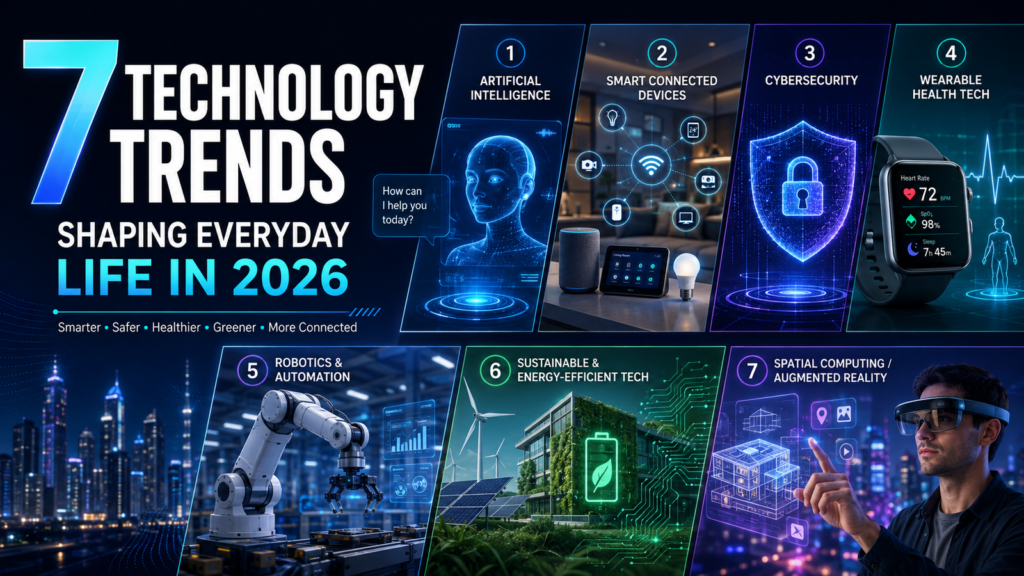
Technology trends in 2026 are changing how we work, communicate, shop, travel, manage our health and protect our personal information. From artificial intelligence assistants to wearable health devices, emerging technology is becoming part of ordinary life faster than ever.
These developments are not limited to large technology companies or specialised industries. They are appearing in smartphones, homes, workplaces, vehicles, hospitals, shops and online services.
According to Gartner’s strategic technology trends for 2026, artificial intelligence, physical AI, multiagent systems, confidential computing and pre-emptive cybersecurity are among the technologies expected to influence organisations over the coming years.
Understanding the leading technology trends in 2026 can help consumers make informed decisions, improve their digital safety and prepare for a more connected future.
Here are seven exciting technology developments shaping everyday life in 2026.
1. Artificial Intelligence Is Becoming More Independent
Artificial intelligence remains one of the most influential technology trends in 2026, but AI is evolving beyond basic chatbots and content-generation tools.
AI systems are becoming more capable of understanding goals, planning actions and completing practical tasks. Instead of simply answering a question, an advanced AI assistant may search for information, organise the results, interact with software and recommend the next step.
This development is commonly known as agentic AI.
AI agents may help people:
- Organise appointments and calendars
- Summarise long emails and documents
- Compare travel or accommodation options
- Prepare reports and presentations
- Track household spending
- Manage customer enquiries
- Research products and services
- Automate repetitive workplace tasks
Gartner lists multiagent systems among its major strategic technology trends, describing systems in which specialised AI agents collaborate to complete complex tasks.
However, greater independence also creates risks. AI systems can misunderstand instructions, produce inaccurate information or take an unsuitable action. The International AI Safety Report 2026 notes that autonomous AI agents may create additional challenges because their actions can be harder for people to interrupt before a failure causes harm.
For this reason, human review remains essential, especially when artificial intelligence is used for financial, legal, medical or employment decisions.
2. Smart Connected Devices Are Becoming More Useful
Connected devices are another major part of technology trends in 2026. Smartphones, televisions, vehicles, watches, security cameras, speakers and household appliances can now communicate with one another through digital networks.
This connected ecosystem is commonly called the Internet of Things, or IoT.
In a modern smart home, connected technology may automatically:
- Adjust lighting based on the time of day
- Manage heating and cooling
- Reduce electricity use when nobody is home
- Detect unusual movement
- Alert residents about an open door
- Identify possible water leaks
- Control appliances through voice commands
The biggest change is not simply that more devices are connected. Smart technology is becoming more personalised. Devices can learn routines, respond to user preferences and make recommendations based on previous behaviour.
For example, a smart thermostat may learn when household members are usually home. A connected lighting system may automatically create different settings for work, relaxation or sleep.
Artificial intelligence is also becoming more closely integrated with connected devices. This combination allows devices to interpret information and respond more intelligently instead of following only fixed instructions.
Readers can explore more general news, ideas and lifestyle developments on The Listening Market homepage.
Although connected technology can improve convenience, users should review device permissions and privacy settings. Smart devices may collect information about location, routines, voice commands and household activity.
3. Cybersecurity Is Becoming an Everyday Priority
Cybersecurity is no longer an issue only for IT departments. It is now one of the most important technology trends in 2026 for individuals, families and businesses.
People increasingly use online services for banking, shopping, healthcare, work, education and communication. As more personal information moves online, cybercriminals have more opportunities to target accounts and devices.
Artificial intelligence is making some digital scams more convincing. Criminals may use AI to produce realistic phishing emails, imitate writing styles, create fake voices or generate misleading images and videos.
The World Economic Forum’s Global Cybersecurity Outlook 2026 reports that accelerating AI adoption, geopolitical fragmentation and unequal cybersecurity capabilities are reshaping the global risk environment.
At the same time, cybersecurity providers are using AI to identify suspicious behaviour, analyse threats and respond to attacks more quickly.
Everyday users can improve their digital security by:
- Using a unique password for every important account
- Enabling multifactor authentication
- Keeping applications and operating systems updated
- Avoiding unexpected links and attachments
- Checking unusual payment requests independently
- Reviewing account activity regularly
- Limiting unnecessary application permissions
- Backing up important files
Passkeys are also becoming more common. A passkey can allow a person to sign in through a trusted device, fingerprint, facial recognition or screen lock rather than relying on a traditional password.
In 2026, digital safety depends on both advanced security technology and careful human behaviour.
4. Wearable Health Technology Is Becoming More Personal
Wearable health devices are among the most visible technology trends in 2026. Smartwatches, fitness bands, rings and connected health sensors are collecting more detailed information about daily activity and wellbeing.
Depending on the device, wearable technology may monitor:
- Heart rate
- Physical activity
- Sleep patterns
- Blood oxygen levels
- Skin temperature
- Stress indicators
- Exercise recovery
- Breathing patterns
Artificial intelligence can analyse this information and present personalised recommendations. A device may suggest taking a break, increasing daily movement or adjusting a sleep routine based on recorded patterns.
Wearables may also identify unusual changes that encourage users to seek professional advice.
The Artificial Intelligence Index Report 2026 highlights the growing influence of AI in medicine and scientific research while recognising that governance, evaluation methods and supporting infrastructure must keep pace with technological progress.
Wearable technology can provide useful information, but consumer devices should not replace professional medical care. A smartwatch reading is not automatically a diagnosis, and concerning symptoms should always be discussed with a qualified healthcare professional.
Consumers should also review how wearable devices store and share health-related data. Health information is highly personal, and privacy policies can differ significantly between applications and manufacturers.
5. Robotics and Physical AI Are Expanding
Robotics is moving beyond traditional manufacturing, making it one of the most practical technology trends in 2026.
Modern robots can combine sensors, cameras, artificial intelligence and automated movement. This allows them to respond to their environment rather than repeating only one programmed action.
Robotic systems are increasingly being used in:
- Warehouses
- Hospitals
- Farms
- Construction sites
- Retail stores
- Hotels
- Manufacturing facilities
- Delivery and logistics operations
In warehouses, robots can transport products and help prepare customer orders. In agriculture, robotic equipment can monitor crops, identify weeds or support harvesting. In healthcare, automated systems may assist with pharmacy tasks, equipment transport and certain medical procedures.
Deloitte describes the convergence of AI and robotics as the movement of intelligence from digital screens into physical machines. Its Tech Trends 2026 report identifies physical AI as an important force shaping business and industrial operations.
The growth of robotics does not necessarily mean every human role will disappear. In many situations, robots are being introduced to support workers by handling repetitive, dangerous or physically demanding tasks.
Human abilities such as communication, empathy, creativity, leadership and judgement will continue to be important. The most successful workplaces may combine these human strengths with the speed and consistency of automated systems.
6. Sustainable Technology Is Receiving More Attention
Sustainability is becoming an important consideration within technology trends in 2026.
Artificial intelligence, cloud services, connected devices and large data centres require electricity, water, hardware and physical infrastructure. As digital services expand, technology companies face growing pressure to reduce energy use and environmental impact.
Sustainable technology developments include:
- More energy-efficient processors
- Low-power AI systems
- Improved battery technology
- Smarter electricity grids
- Renewable energy infrastructure
- Efficient data-centre cooling
- Repairable electronic devices
- Improved recycling programmes
One increasingly important development is edge computing.
Edge computing processes information directly on a phone, sensor, vehicle or local device instead of transferring all data to a distant cloud server. When combined with AI, it is often called edge AI.
Processing information locally can provide several benefits:
- Faster responses
- Reduced internet dependence
- Greater privacy
- Lower data-transfer requirements
- Improved performance in remote locations
New types of computing may also improve energy efficiency. PwC’s overview of emerging technologies explains that neuromorphic computing is designed to imitate aspects of the human brain and may eventually support faster AI processing with lower energy consumption.
Sustainable technology will become increasingly important as consumers and businesses consider energy costs, electronic waste and the environmental effects of digital services.
7. Spatial Computing Is Blending Digital and Physical Life
Spatial computing is one of the most visually exciting technology trends in 2026.
It combines digital information with the physical environment through technologies such as:
- Augmented reality
- Virtual reality
- Mixed reality
- Smart glasses
- Motion sensors
- Three-dimensional interfaces
Instead of viewing information only on a traditional screen, spatial computing allows users to interact with digital objects placed within the environment around them.
Possible uses include:
- Previewing furniture inside a home
- Trying clothing or accessories virtually
- Receiving visual navigation instructions
- Viewing repair guidance over physical equipment
- Exploring a property remotely
- Practising skills through immersive simulations
- Attending interactive virtual meetings
- Learning through three-dimensional educational models
Spatial computing is particularly relevant to education, healthcare, property, architecture, design, tourism, training and remote collaboration.
PwC notes that augmented reality is expanding across training, onboarding, product demonstrations and field services. Its integration with artificial intelligence and connected devices may lead to more personalised and context-aware experiences.
Current barriers include device cost, battery life, comfort, privacy and the limited availability of valuable content. However, smart glasses and mixed-reality devices may become more practical as hardware becomes lighter and software becomes easier to use.
You can browse additional articles in the technology section of The Listening Market for more updates on digital innovation and emerging technology.
How Technology Trends in 2026 Will Affect Daily Life
The most important technology trends in 2026 are becoming interconnected.
Artificial intelligence is being added to smart devices. Wearable health products connect to online platforms. Robots use AI, sensors and cloud systems. Cybersecurity tools protect these connected environments.
This integration can create smoother and more personalised experiences. However, it can also increase the amount of information collected about individuals.
People will need stronger digital literacy to use these technologies responsibly. This includes understanding:
- How to check AI-generated information
- How personal data is collected
- How online accounts should be protected
- Which permissions applications genuinely need
- When automation should be reviewed by a person
- How to recognise misleading digital content
Businesses and governments will also face pressure to develop clearer rules covering data protection, artificial intelligence, transparency, security and accountability.
Technology will deliver its greatest benefits when innovation is balanced with privacy, fairness and responsible human oversight.
Benefits of Technology Trends in 2026
The leading technology trends in 2026 may create several benefits for individuals and organisations.
These benefits can include:
- Faster access to information
- More personalised digital services
- Improved workplace productivity
- Better health and fitness insights
- Safer online experiences
- More efficient energy use
- Reduced repetitive work
- More immersive learning opportunities
The value of each technology will depend on how effectively and responsibly it is implemented.
Challenges Connected With New Technology
New technology also creates challenges that should not be ignored.
Common concerns include:
- Loss of personal privacy
- Cybersecurity risks
- AI-generated misinformation
- Technology dependence
- Changes to employment
- Unequal access to digital services
- High energy consumption
- Unclear responsibility when automated systems fail
Consumers should not assume that every new device or service is automatically useful. Before adopting new technology, it is sensible to consider the genuine benefit, total cost, privacy implications and security protections.
Frequently Asked Questions
What are the biggest technology trends in 2026?
The biggest technology trends in 2026 include agentic artificial intelligence, connected smart devices, AI-powered cybersecurity, wearable health technology, physical AI and robotics, sustainable computing and spatial computing.
How are technology trends in 2026 changing everyday life?
Technology trends are changing everyday life by automating routine tasks, improving digital services, connecting household devices, providing personalised health information and introducing new ways to work, shop and communicate.
What is agentic AI?
Agentic AI refers to artificial intelligence that can plan and perform several actions to achieve a goal. An AI agent may interact with software, collect information and complete tasks with limited human involvement.
Why is cybersecurity important in 2026?
Cybersecurity is important because people store increasing amounts of personal and financial information online. AI-generated phishing, identity fraud, deepfakes and automated cyberattacks can make digital threats harder to identify.
Will robots replace human workers?
Robots may replace certain repetitive or dangerous tasks, but many industries will use robotics to support rather than completely replace workers. Human creativity, communication, empathy and judgement will remain valuable.
What is sustainable technology?
Sustainable technology includes hardware, software and infrastructure designed to use less energy, generate less electronic waste and reduce environmental impact.
What is spatial computing?
Spatial computing combines digital information with physical environments through augmented reality, virtual reality, sensors, smart glasses and three-dimensional interfaces.
Final Thoughts on Technology Trends in 2026
Technology trends in 2026 are bringing artificial intelligence, connected devices, cybersecurity, wearables, robotics, sustainable computing and spatial experiences into everyday life.
These innovations offer exciting opportunities to improve convenience, productivity, health, safety and communication. However, their success will depend on responsible development, strong cybersecurity, transparent data practices and informed users.
The future will not be shaped by technology alone. It will be shaped by the decisions people, businesses and governments make about how that technology should be used.
By following the latest technology trends in 2026, consumers can prepare for change, protect their information and make smarter decisions in an increasingly connected world.