
A perspective piece from The Listening Market
Entertainment Trends rarely announce themselves loudly — they usually show up first as a small shift in what people talk about at dinner, then quietly become the default way a lot of people spend their evenings.
Our take: the Entertainment Trends defining 2026 aren’t really about any single show, game, or format — they’re about audiences wanting more control over how, when, and with whom they experience entertainment. This isn’t a data-backed forecast, just our read on where attention seems to be shifting.
Here’s how we see it.
What Entertainment Trends Seem to Be Shaping Audience Behavior in 2026?
A few patterns stand out as things audiences increasingly seem to gravitate toward:
- Shorter, snackable formats. Content built to be consumed in a few minutes rather than a few hours seems to be winning attention even among people who still love long-form entertainment.
- Interactive and participatory formats. Audiences seem less content to simply watch — choosing outcomes, voting, or shaping a story in real time feels like it’s becoming an expectation, not a novelty.
- Nostalgia-driven revivals. Familiar characters, eras, and styles returning in updated forms seem to be resonating strongly, especially with audiences who grew up with the originals.
- Niche communities over mass audiences. Smaller, deeply engaged fan communities seem to matter more than broad, general audiences did a decade ago.
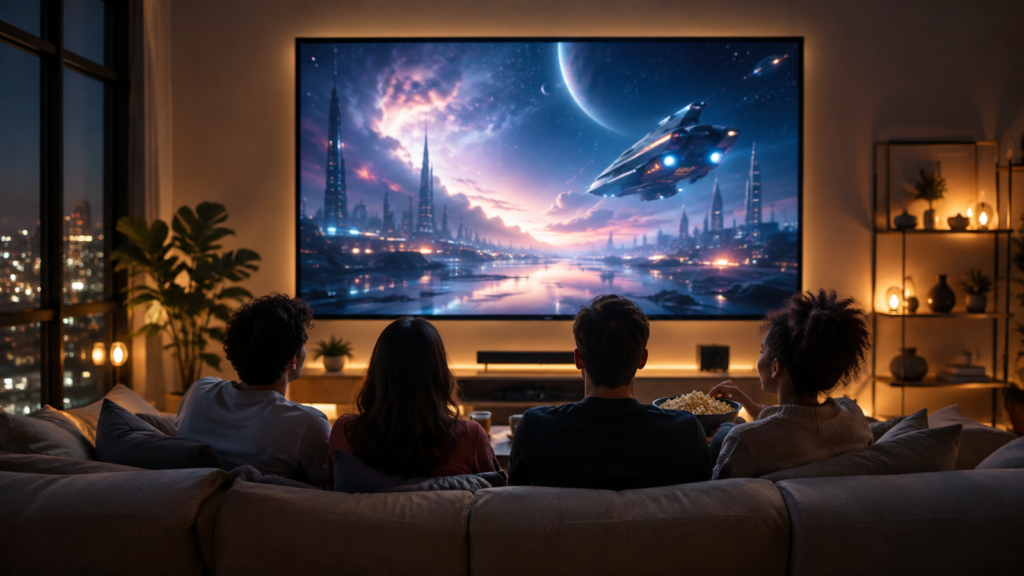
- Co-viewing and shared experiences. Watching or playing together — even remotely — seems to be replacing some of the appeal of consuming entertainment alone.
- Creator-led storytelling. Individual voices and personal perspectives seem to be pulling attention away from traditional, studio-driven formats.
- Multi-format storytelling. A single story world extending across shows, games, and other formats seems to keep audiences engaged longer than a single format could alone.
- Background and ambient entertainment. Content designed to accompany another activity, rather than demand full attention, seems to be quietly growing in daily use.
- Audience-driven direction. Real-time feedback and reactions increasingly seem to shape where a story or format goes next, rather than following a fixed plan.
None of these exist in isolation — a lot of what’s compelling right now seems to sit at the overlap of two or three of these at once.
Why Do Audiences Seem to Want More Control Over Entertainment?
Our sense is that this connects to a broader shift in how people spend limited free time. When there’s more entertainment available than anyone could realistically get through, choosing passively starts to feel wasteful — so audiences seem to be gravitating toward formats that let them shape the experience rather than just receive it.
That desire for control also seems to explain why niche communities and creator-led formats are gaining ground. A smaller, more specific experience that actually matches someone’s taste can feel more valuable than a broad one that only partially does.
Are These Entertainment Trends Actually New, or Just Accelerating?
Honestly, most of them aren’t brand new — audiences have always loved shared experiences, nostalgia, and stories that stretch across formats. What seems different in 2026 is the pace and scale at which these preferences are being acted on, not the preferences themselves.
Our take: technology has mostly removed the friction that used to limit these habits — participation, niche discovery, and multi-format storytelling used to require far more effort than they do now.
Should We Be Skeptical of “Trend” Claims Like These?
We think a fair amount of skepticism is healthy here too. Entertainment trends are notoriously hard to call definitively — audience taste shifts quickly, and what looks like a defining shift can turn out to be a short-lived spike.
That’s part of why we’re framing this as our own read rather than a settled forecast. The Entertainment Trends worth paying attention to are usually the ones that hold up a year or two later, not the ones that generate the most immediate buzz.
What Might This Mean for How Entertainment Gets Made?
If these patterns continue, it’s reasonable to expect more entertainment built around flexibility from the start — formats designed to be interactive, shareable, or extendable across multiple platforms rather than locked into one fixed shape.
That’s a meaningful shift in approach, not just in audience taste — though whether it changes how most entertainment actually gets made, or stays a growing niche within it, is genuinely uncertain.
Where We Think This Is Heading Next
If current patterns continue, we’d expect Entertainment Trends to keep favoring participation, community, and flexibility over passive, one-size-fits-all formats. We’d also expect the line between “creator” and “audience” to keep blurring, as more people shape the entertainment they consume rather than simply watching it unfold.
None of this is a certainty — it’s our interpretation of where things seem to be moving, and we’ll keep watching it closely. For more perspectives like this, browse our other reads on The Listening Market.
This piece reflects the perspective and observations of The Listening Market team, not data analysis or research findings. We share it as a starting point for conversation, not a definitive source.